Tag Archive for: Element Care PACE

How a shuttered hospital site in Lynn is being transformed into affordable housing for seniors

This article was originally published on CommonWealth Beacon.

WHEN LYNN’S only hospital shuttered in 2020, it was a devastating blow for the North Shore city of 100,000 in the throes of the pandemic.

“The closure of Union Hospital is still a source of pain and frustration in this community,” Mayor Jared Nicholson said. “For a city of our size not to have a hospital is an indictment on the health care system.”

But one 10-acre section of the site has already been developed into a community of 26 single family homes for adults over the age of 55 called Woodland Village. And next year, the community will see the five remaining acres of the parcel restored into a 150-unit affordable housing community for seniors.

2Life Communities, an affordable senior housing developer and operator, broke ground on the $85 million project — called Solimine House — in December. Construction is expected to be completed in October 2027, with the resident application process opening next spring for adults age 62 and older with incomes up to 60 percent of the area median income (AMI).

Local leaders say the development will help alleviate the city’s housing shortage and provide an affordable, accessible option for some of Lynn’s most vulnerable residents. The new development will be connected via a covered walkway to Element Care, a nonprofit health care organization located next door, and its Program of All-Inclusive Care for the Elderly (PACE) center, which serves patients who are enrolled in Medicaid and Medicare. Massachusetts General Brigham’s Lynn Urgent Care and Medical Office Building are also next door.

“What’s particularly exciting about this project is that it integrates approaches to housing and health care, and those are two of the thorniest, most challenging issues we face,” Nicholson said.

After the hospital closure, David Solimine, a local developer and philanthropist who manages Solimine Charitable Corporation, bought the complex for $1 million and soon after demolished it. Community members made it clear that they wanted senior housing on the site in the Metropolitan Area Planning Council’s 2018 Lynn Union Hospital re-use planning study.

“I live right around the corner from the site, and it was my neighborhood hospital,” Solimine said.

Solimine partnered with 2Life Communities and gave them five acres while his charitable corporation built Woodland Village on the other 10 acres. (Solimine manages the corporation as an unpaid volunteer and 100 percent of its income, including the sale proceeds from Woodland Village, is used for charitable purposes in the Lynn area, according to Solimine.)

“This is an easy one,” said Magnolia Contreras, Solimine’s wife and a lifelong Lynn resident. “You’re providing homes to people with limited income in an innovative way where they are going to get health care and other community-level services, build a culture, and build a community. We’ve never seen anything like this in Lynn.”

Even though 38 percent of all affordable rental units in Massachusetts are set aside for older adults, supply is limited. There are more than 460,000 low-income elderly households in the state and only 83,000 affordable rental units for this demographic, according to a 2025 Special Commission on Senior Housing report.

Meanwhile, Massachusetts ranks as the second worst state in the nation after New York for elder economic security, largely due to high housing costs, according to a 2026 report from UMass Boston.

The median household income among Lynn residents age 65 and older is $41,000 compared to the city’s overall median household income of $75,000. Comparatively, seniors in Massachusetts have a median household income of nearly $69,000. Roughly 20 percent of seniors in Lynn live below the poverty line compared to nearly 14 percent of the city’s overall population.

“The desperate need for housing that is affordable to Lynn’s older adults, and the added benefits of our ‘aging in community’ model are going to be a tremendous asset to the community,” said Lizbeth Heyer, president of 2Life Communities.

Solimine House will include 40 units rented to households earning up to 60 percent of AMI, 69 units rented to households earning up to 50 percent of AMI, and 39 units rented to households earning up to 30 percent of AMI. Two rent-free apartments will house live-in staff that will be on call 24 hours a day for residents.

City leaders are hopeful that projects like Solimine House will alleviate other housing pressures by providing a place for seniors to comfortably age while also freeing up more housing for families.

“There is a lack of options for older people to downsize or move into a senior housing community,” Heyer said. “We have a lot of older adults in Lynn and in this state that are living in unsustainable housing situations, where they’re paying a massive amount to live in an apartment or a house that would be more appropriately sized for a family.”

Medicare Mandates Cognitive Screening, but do PCPs have the Tools to Act Confidently?

This article was originally published on MedCity News.

The solution isn’t about creating more referral pathways, but about building the measurement infrastructure that enables excellent primary care providers to act confidently on their observations.

As a geriatrician, I see the significant gap between what policies intend and the reality in practice, and it’s not always what you expect. We measure blood pressure, weight, and cholesterol without hesitation. These screenings are effective because they are routine, but also because they provide clear data that helps providers make fast, crucial decisions. A blood pressure reading of 180/110 requires immediate action and primary care providers have the tools and the confidence to respond.

Medicare’s requirement for cognitive assessment in annual wellness visits is well-meaning. However, it has an unintended consequence. Unlike other areas of health we ask PCPs to measure, providers are expected to spot cognitive decline without having the precise tools they need to act with confidence, resulting in systemic inefficiencies that clog the entire system.

The confidence crisis hidden in plain sight

Every three seconds, a new case of dementia is diagnosed worldwide. What happens next for these patients relies entirely on the healthcare system they encounter. I’ve seen how, despite good intentions, our flawed system fails these patients regularly. They come to my office after months of uncertainty, having been referred by their primary care providers. These are the doctors who know them best. The ones who first noticed the warning signs, yet felt they had to refer rather than take action themselves.

And it’s not because of a lack of competence. It’s because of a lack of confidence. Particularly, a lack of confidence in the data they collect and how to turn it into actionable care.

Imagine this scenario: During an annual wellness visit, a longtime patient scores 26 on the MoCA. That’s technically considered a “normal” score, but it’s down from a score of 28 two years ago. Their primary care provider notices this decline, but has limited insight into what’s driving it. Is this just normal aging? Signs of mild cognitive impairment? Worth monitoring? Worth doing a more fulsome work-up against? The patient and their family are worried, but the data is unclear.

Faced with uncertainty, possibly coupled with the weight of having to deliver a diagnosis with potentially life-changing implications, most providers take the safer route: they refer to a specialist. This is a reasonable response given the situation, but it leads to a cascade of unintended consequences.

The hidden cost of low-confidence referrals

To see a neurologist, the average wait is 34 days. For nearly one in five patients, it’s three months or more. But these are just the statistics. What the numbers don’t show is that many of these referrals aren’t from complex cases needing specialist expertise. Instead, they’re from primary care providers who lack confidence in their cognitive assessment data. These providers already know how to identify cognitive decline and use screening tools. They’ve cared for their patients for years and understand their baselines, family dynamics, and overall health better than any specialist probably could. What they lack isn’t clinical judgment; it’s the precise measurements that create confidence in their clinical decision making.

When a provider checks blood pressure and finds that it’s high, they don’t hesitate to act. They adjust medications, recommend lifestyle changes, or formulate a monitoring plan on the spot. They know time is of the essence and they can move quickly because they trust their data. But when that same provider notices cognitive changes and only has blunt screening tools or patient-reported concerns to rely on, their often immediate recourse is a referral. That’s not because the case is complex; it’s because their tools don’t provide detailed enough insights to act on.

The efficiency we’re losing

This gap in confidence is hurting the efficiency of our system. It worsens due to the overwhelming demands placed on primary care providers during annual wellness visits. PCPs are expected to pack a lot into these very short appointments: preventive screenings, chronic disease management, medication reviews, lifestyle counseling, and cognitive assessments. With only 15-20 minutes to cover everything, it’s understandable for providers to feel that gathering the detailed data needed for a confident cognitive assessment isn’t feasible at the point of care.

And so begins a vicious cycle: lacking time and tools for thorough cognitive evaluations, PCPs default to specialist referrals, even for cases they might otherwise manage. The result? Specialists like me spend significant time evaluating patients whose cognitive concerns could be handled, at least initially, in their primary care providers office. But only if those providers had more thorough assessment tools that also met the speed of evaluation required.

And for patients with actually complex neurological conditions – they also feel the impact. They’re left waiting longer for expert care because the system is overwhelmed with cases that don’t actually necessitate that level of specialization. So we end up failing everyone: PCPs feel stressed and under-equipped, patients face unnecessary delays and anxiety, and specialists like me are diverted from the complex cases that could truly benefit from my focus and timely expertise.

But it doesn’t need to be an either/or situation. We don’t need to choose between primary care management and specialist referrals. I believe it is possible to have a system that empowers primary care providers to confidently manage what they can, using efficient, on-site tools that fit within the time limitations of real practice, while keeping specialist resources for cases that truly require advanced knowledge.

What does confidence look like in practice

Imagine instead: during that same annual wellness visit, the provider uses a precise cognitive assessment that provides detailed, domain specific data and the ability to benchmark performance and easily compare it year over year and to a normative database of health individuals. The patient’s scores indicate subtle but consistent decline across specific cognitive areas, along with clear risk stratification, actionable insights, and guided care plan creation. The provider now has a depth of data they can trust and the tools at their fingertips to create actionable next steps.

With confidence, they can:

● Start evidence-based interventions for modifiable risk factors

● Develop targeted monitoring plans

● Offer clear, data-supported guidance to patients and families

● Reserve specialist referrals for cases showing significant concerns that need advanced evaluation

This isn’t about replacing specialists; it’s about optimizing the entire system so each provider can operate at the top of their ability.

When healthcare systems adopt this approach, efficiency spreads through every level of care. Primary care practices no longer need to rely as heavily on specialist referrals to help support every patient presenting with cognitive concerns. Instead, their referrals focus on cases that actually need specialist intervention. And trust me, specialists welcome this change because it means we can apply our expertise where it matters most instead of sifting through obvious cases.

The financial impact of a better triage system is also significant. Fewer specialty care bottlenecks lead to shorter wait times and better use of resources. Improved documentation supports better reimbursement for cognitive health services. Medicare’s focus on value-based care suddenly benefits providers who show real outcomes through early detection and intervention.

Beyond the system benefits, managing population health becomes feasible for the first time. Rather than waiting for crises, health systems can identify at-risk groups and act proactively. They can monitor outcomes, adjust protocols, and demonstrate a return on investment in cognitive health programs.

More than economics: A case for human impact

Maybe most importantly, the patient experience vastly improves. Instead of enduring months of worry and uncertainty, people leave appointments with a clear understanding of their cognitive health, specific steps to follow, and confidence that they are being monitored correctly. Families shift from panic to constructive involvement in care.

Early detection and intervention delay nursing home placement by an average of two years. This represents millions in avoided costs. It also means reducing avoidable risks. Emergency department visits decline as cognitive issues that can lead to things like falls or missed medications are managed proactively rather than reactively.

However, the true win isn’t financial — it’s families staying together longer, reduced stress on caregivers, and preserving the independence and dignity of patients. The entire system operates more smoothly and offers a better quality of life for the people it’s designed to serve.

The tools already exist

Through decades of practice, I’ve learned that the tools we use directly influence the care patients receive. Given the brain’s complexity, no area is this more true than in measurement of cognitive health. Scientifically validated, precise digital cognitive assessment technology is available today, providing the detailed, domain-specific results providers need to act with confidence.

We don’t need radical changes to the system. We need to apply the same measurement principles that work for cardiovascular health to brain health: regular, precise, actionable assessments that build provider confidence and enable appropriate care at every level.

An all-hands-on-deck approach

The cognitive health crisis requires us to use our healthcare system’s full capacity efficiently. Primary care providers see patients regularly, understand their complete health stories, and are ideally suited to manage cognitive health — when they have the tools that inspire confidence instead of uncertainty.

Having focused my career on aging and seeing its connection to cognitive health, I believe the solution is not about creating more referral pathways, but about building the measurement infrastructure that enables excellent primary care providers to act confidently on their observations.

Expertise exists throughout our system. The tools to support it are available. What we need now is the commitment to ensure every provider — from primary care to specialists — has the specific data they need to deliver the right care at the right time, with confidence.
 

Element Care PACE Appoints New COO and CGRO to Drive Next Phase of Growth

This article was originally published on Element Care.

Element Care PACE Appoints New COO and CGRO to Drive Next Phase of Growth Lynn, MA – August 19, 2025 – Element Care, a leading Program of All-Inclusive Care for the Elderly (PACE) and managed care provider for Senior Care Options (SCO), is pleased to announce the appointment of Calay Ip, as the organization’s new Chief Operating Officer (COO). Calay is a highly accomplished and results-oriented healthcare executive with over 20 years of leadership experience driving strategic implementation, optimizing program design, and enhancing financial performance within complex healthcare organizations, with prior experience in Massachusetts’ PACE and SCO programs.

Calay is an expert in scaling operations for financial improvement and operational growth in senior care programs. With her deep knowledge of PACE and SCO programs, she will implement strategic growth initiatives, optimize program operations, and enhance business performance for meaningful outcomes at Element Care. Her extensive expertise includes key leadership roles at Point32 Health, and Mass General Brigham Health Plan, where she established herself as an industry leader in healthcare innovation and operational excellence. Calay holds a Master’s in Business Administration (MBA) from Boston University Graduate School of Management with a specialization in Health Sector Management. She worked previously as the Vice President of Senior Care Programs at Neighbor Health in East Boston.

“In my over two decades of leadership experience across healthcare segments including PACE, SCO, and Medicaid, I’ve found my niche in optimizing operational scalability and leading senior care programs through phases of rapid growth,” said Calay Ip, COO at Element Care. “I’m honored to join Element Care and make an impact alongside a dedicated team that pushes forward the company’s vision of compassionate, affordable, coordinated care for seniors.”

“We’re excited to welcome Calay as our new COO, a leader with a proven track record of executing scalable operations and driving high performance initiatives. With Calay’s dedication to optimizing operations within senior care programs, we are confident that she will continue to grow our unique care model for seniors in Massachusetts,” said Douglas Thompson, CEO at Element Care.

The appointment comes as Mary Ellen Dugan, former COO, takes on a new role as Chief Government Relations Officer (CGRO). In this role, Mary Ellen will lead the company’s efforts in building and maintaining strong relationships with federal, state, and local government officials and regulators, serving as a key advocate in Element Care’s mission. Mary Ellen has over 25 years of leadership experience within the healthcare sector, focusing her career on serving marginalized populations in government funded settings. She has spearheaded multi-year major capital expansion projects, including the successful development of three PACE centers and the relocation of Element Care’s corporate headquarters.

“Throughout my career, I’ve been committed to improving care for vulnerable and underserved populations, and my time at Element Care has only deepened that commitment,” said Mary Ellen Dugan, CGRO at Element Care. “I look forward to continuing to serve our PACE community in a different capacity by advocating for policies that will expand access to this life-changing model of care.”

“As we plan for our next phase of strategic growth at Element Care, strong, visionary leadership is crucial. Mary Ellen has been instrumental in shaping our success for the past 15 years, and in her new role as CGRO she will advocate for PACE and SCO models of care and strengthen our voice with policymakers,” said Thompson.

For more than 30 years, Element Care has provided the highest quality comprehensive healthcare to thousands of at-risk seniors. Currently, Element Care serves over 1,100 PACE participants and 1,850 SCO members across communities in Essex County, Merrimack Valley, and Greater Boston. PACE is a federally funded health care program that offers a range of services including preventive, primary, acute and long-term care.

About Element Care

Element Care is a non-profit healthcare organization with a simple mission: to help older adults live safely and comfortably in their homes and communities for as long as they can, keeping their stays in hospitals and nursing facilities as minimal as possible. Founded in 1994, Element Care’s PACE program was established as a joint venture of the Lynn Community Health Center and Greater Lynn Senior Services to bring PACE to seniors in the community. In 2004, Element Care partnered with Commonwealth Care Alliance to provide comprehensive clinical case management to at-risk SCO members. The organization offers a holistic approach to care that includes medical, social, and wellness services tailored to the unique needs of each participant and member.

Why PACE programs are joining forces with senior housing

This article was originally published on Modern Healthcare.

Operators of a program designed to keep older adults out of nursing homes are looking to attract enrollees by integrating with senior housing communities.

Read the full article here.

New Element Care CEO Sets the PACE for Elderly Health

This article was originally published on ItemLive.com.

LYNN — Swampscott resident Doug Thompson stepped into the role of Element Care’s CEO at the end of September and has continued the nonprofit’s mission of providing healthcare to older adults.

Thompson worked in the healthcare industry for more than 30 years before arriving at Element Care, working in leadership positions at companies throughout the area. He also founded Perfect Health, which provided home-based primary care to seniors.

“Being here at Element Care, for me, is a perfect, natural culmination of everything that I’ve done in the past,” Thompson said. “I feel like I’ve really found my home.”

Element Care’s Program for All-Inclusive Care for the Elderly (PACE) provides participants ages 55 and older with an interdisciplinary team of 11 staff members to provide them with comprehensive, individualized care. The team offers everything from home-based services to access to the facility’s memory care unit.

“If you know anything about what it’s like to take care of an aging parent … it is exhausting,” he said. “Here, we take care of all of it.”

Thompson said he visited all seven of Element Care’s facilities – Lynn, Beverly, Brighton, Gloucester, Lowell, Lynn and Methuen – early on in the new position and saw the passion and excitement among all the employees.

“Building a great place for people to work enables us to attract great talent and delivers great care for our participants,” he said.

He also said he hopes to work with organizations in the Lynn area to expand Element Care’s reach and impact, such as Lynn Community Health Center and Greater Lynn Senior Services.

“We look forward to partnering with everybody here in Lynn to make sure that every single person that can benefit from this, at least knows about it and, ideally, is part of it,” Thompson said.

Element Care on PACE for Grand Opening in Lynn

This article was originally published on Item Live.

LYNN — Element Care cut the ribbon for its newest Program of All-Inclusive Care for the Elderly (PACE) site, the Magnolia A. Contreras Day Center, on Thursday.

Subscribe for the full article.

Element Care PACE Opens New Site to Expand PACE Services to Seniors in Massachusetts

This article was originally published on Business Wire.

Massachusetts-based non-profit expands PACE program offerings to underserved adults over 55 in Lynn and surrounding areas

LYNN, Mass., June 10, 2024–(BUSINESS WIRE)–Element Care PACE, a non-profit healthcare organization helping older adults live safely and comfortably in their homes, is celebrating the opening of its new PACE site in Lynn, Massachusetts. With 13,000 square feet, the new PACE Center will service as the new administrative headquarters and provide essential, comprehensive medical services and activities to keep adults over 55 healthy and engaged in their community.

“For the last three decades, we’ve taken pride in providing quality care for adults by bringing all medical services under one roof, including interdisciplinary care teams, an emphasized focus on preventive medicine, and a commitment to personalized attention,” said Robert Wakefield, Jr, Chief Executive Officer at Element Care PACE. “The opening of this new PACE site marks the next chapter for Element Care PACE, and the ability to serve more Massachusetts seniors in need.”

Amenities at the new site include a teaching kitchen, library, activities room, sunroom, memory care and exam facilities, gardens, and an enclosed courtyard. The site includes murals in the first floor Woodland Rehab hallway, painted by students in the Raw Art Works youth arts organization. There are also 2Life Communities senior housing apartments being built next door to provide affordable housing solutions for eligible seniors.

The new PACE center opens as a boom is expected in the aging population, with the World Health Organization estimating one in six people in the world will be aged over 60 years or over by 2030. Nationally, Massachusetts is one of two states with the highest number of PACE enrollees.

“As the population of aging seniors continues to grow, it is crucial to provide access to quality, coordinated healthcare,” said Robert Wakefield, Jr. at Element Care PACE. “The aging population in the North Shore communities of Massachusetts will benefit greatly from the expansion of Element Care PACE.”

The Medicare and Medicaid-funded Program of All-Inclusive Care for the Elderly (PACE) provides comprehensive medical services, helps reduce barriers to care and offers a proactive and person-centered approach to senior healthcare, particularly for low-income seniors. PACE unified care teams cover the facilitation of several aspects of medical care including basic well and sick visits, dental, eye, and hearing care, rehabilitation, along with screenings, therapy appointments, and more. Studies show PACE participants have lower rates of hospital stays and readmissions and improved quality of life.

Danvers Hosts 2024 PACE Senior Olympics

This recording was originally posted on WBZ News Radio. Listen to the full recording here.

John Coolang of Element Care, which operates the senior centers, said the competition that’s been running since 2011 is a great way for seniors to interact and socialize with others from across the region. “I think for the participants it gives them a chance to meet other participants in the organization and compete and have fun.”

Meanwhile, Joe from Methuen said meeting other people is great, but so is competing. “Every muscle in my body tingles,” he said. “I look forward to this every year, and I will look forward to it for the rest of my life.”

PACE: Where You Belong – Part 1: Transforming Lives Through Community-Centric Care for Older Adults

This year, as we celebrate National PACE Month-themed “PACE: Where You Belong,” we begin our 3-part blog series to spotlight each of our eight PACE programs, whose goal is fostering community and connectivity—fundamental elements for individual well-being. For our first blog, we hear stories from three PACE programs; Serenity Care, Mercy LIFE, and Element Care that exemplify the PACE model’s ability to cultivate a compassionate, interconnected community.

The Serenity PACE Approach: Human-Centered Care and Connection

“Who could have ever thought that my ‘golden’ years would turn out to be the happiest period of my life?”

These heartfelt words came from an extraordinary participant who became part of the Serenity Care PACE community four years ago. Initially, she faced the intimidating option of moving into a nursing home, a proposal made even more daunting by language barriers, unfamiliar foods, and her aversion to institutional settings stemming from past experiences.

Then came her serendipitous discovery of Serenity Care PACE. Today, she leads a life of independence and community involvement, especially within her faith group. Her daughter lives in Los Angeles and has witnessed her mother’s metamorphosis:

“Before PACE, every call with my mom left me in tears. She was lonely and anxious, and getting clear information about her health was a struggle. The guilt was overwhelming. Now, she’s cheerful, shares stories about her days at the center, and, most importantly, I’m kept in the loop about her health and medications. Our lives have improved dramatically. We’re so grateful.”

A Lifeline for Independence: The Mercy LIFE PACE Story

In November 2019, Mercy LIFE came into contact with a younger, older adult living with his mother, his lifelong primary caregiver. Born with a brain injury, his life took a turn when his elderly mother could no longer provide the level of care he needed, contemplating a move to long-term care facilities as a last resort.

The man, known for socializing at the neighborhood corner store, often could not return home, resulting in numerous falls from his wheelchair. Faced with this predicament, his sister began exploring alternatives, eventually stumbling upon the PACE program at Mercy LIFE.

After an initial meeting with the family, it was evident that his 86-year-old mother was at her breaking point. Taking a chance on PACE, they enrolled him in the day center, where he now receives personal care and undergoes physical therapy. Now, not only can he use his walker for short distances, but he’s also become a cheerful part of the community, participating in activities and socializing enthusiastically. Thanks to Mercy LIFE PACE, he can age in place, right in the comfort of his home.

A Personal Perspective: Carol Pallazolla and Element Care PACE

Carol Pallazolla, a resident of Gloucester, serves as the Education and Outreach Coordinator for Element Care PACE. After witnessing her mother, Mary, face health challenges, she encouraged her to join Element Care PACE.

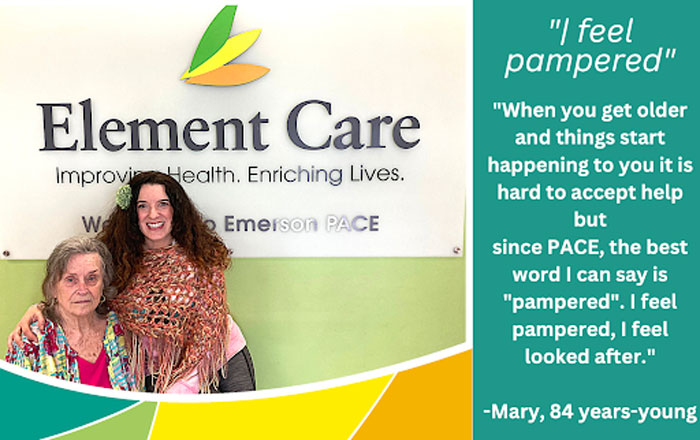
“When I joined PACE, I met so many nice people. My nurse, Emma, and my Physical Therapist Grace, to name a few. I have had shoulder pain for so long, and for the first time in a long time…I am pain-free,” said Mary.

Before joining the program, Mary was saddled with a $45 co-pay for each physical therapy session and struggled with medication costs. Now, she not only receives her medications but also gets prescribed Eliquis, which she couldn’t afford previously. Additionally, Mary got a free Grandpad tablet, through which she participates in virtual exercise classes, plays games, and even finds a lifeline during a power outage to connect with her daughter.

Mary sums it up best:
‘I feel pampered…..When you get older, and things start happening to you, it is hard to accept help, but since PACE, the best word I can say is “pampered.” I feel pampered, I feel looked after.’

As we continue to navigate the complexities of healthcare and aging, especially in these isolating times, the stories above illustrate why PACE isn’t just a program—it’s a community where older adults genuinely belong.